
Auxilium Biotechnologies today announced a major milestone in space biomanufacturing with the successful bioprinting of kidney and liver tissues aboard the International Space Station (ISS), marking the first time either tissue type has been manufactured in space. Auxilium’s bioprinted biological tissues and nerve repair implants returned to earth on Mission AXLM-3 that flew on NASA’s SpaceX CRS-34 and splashed down off the California coast on June 17th, 2026, at 5:11am Pacific.
This press release features multimedia. View the full release here: https://www.businesswire.com/news/home/20260709079391/en/
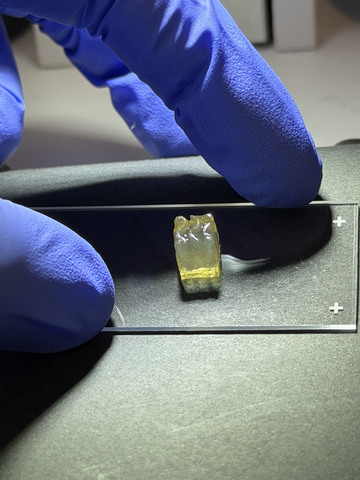
Biological tissues: Auxilium Biotechnologies successful bioprinted kidney and liver tissues aboard the International Space Station (ISS), marking the first time either tissue type has been manufactured in space.
During the mission, Auxilium’s AMP-1 orbital bioprinter successfully manufactured kidney, liver, and cartilage tissues while also producing 28 nerve repair implants. The achievement represents the first demonstration of kidney tissue manufacturing in space, the first demonstration of liver tissue manufacturing in space, and the first mission to manufacture three distinct tissue types during a single spaceflight. The production of multiple tissue types and clinically relevant nerve repair implants represents the first demonstration of a scalable, multi-product biomanufacturing platform in space.
Equally important, the mission demonstrated the ability of a single autonomous manufacturing platform to produce both living tissues and implantable medical products during the same flight. The simultaneous production of multiple tissue types alongside 28 nerve repair implants highlights not only the versatility of the platform, but also its scalability and higher-throughput manufacturing in space.
The kidney and liver tissues were manufactured in support of research conducted by the Wake Forest Institute for Regenerative Medicine (WFIRM) using the institute’s cells and tissue designs. Auxilium provided the orbital manufacturing platform that enabled tissue fabrication in microgravity.
“This mission represents a significant milestone for both Auxilium and the future of space biomanufacturing,” said Jacob Koffler, PhD, MBA, CEO of Auxilium. “For the first time, we successfully bioprinted kidney and liver tissues in space, demonstrating that complex biological products can be manufactured in orbit. We also produced cartilage tissue and 28 nerve repair implants during the same mission using the same manufacturing platform. The ability to manufacture multiple tissue types alongside clinically relevant medical products highlights both the versatility and scalability of our technology. These results build on our previous demonstration of large-scale medical device manufacturing in space and represent another step toward establishing practical production capabilities for biomedical products beyond Earth.”
Dr. Anthony Atala, MD, Professor and Director of the Wake Forest Institute for Regenerative Medicine (WFIRM) commented, “Successfully bioprinting living liver and kidney tissue aboard the International Space Station marks an important step forward for regenerative medicine. The uniform cell distribution achieved aboard the space station points to real possibilities for manufacturing medical devices and tissues in space.”
Demonstrating a Versatile and Scalable Manufacturing Platform
The ability to manufacture diverse product classes at meaningful production volumes represents an important step toward establishing practical industrial and biomedical manufacturing capabilities in space.
Many space manufacturing demonstrations focus on a single product type or proof-of-concept experiment. In contrast, this mission demonstrated a platform capable of producing multiple tissue types and implantable medical products during the same operational cycle. Such flexibility will become increasingly important as commercial space platforms evolve into multi-user research and manufacturing hubs supporting biotechnology, healthcare, and advanced materials development.
“This mission marks an exciting step forward for in-space biomanufacturing and demonstrates what can be achieved when innovative technology is paired with strong collaboration,” said Isac Lazarovits, Vice President of Engineering at Auxilium Biotechnologies. “Successfully manufacturing kidney, liver, and cartilage tissues while simultaneously producing 28 nerve repair implants demonstrates both the flexibility and scalability of our platform. Demonstrating multiple product classes and meaningful production volume within a single mission is an important milestone as we continue advancing toward routine manufacturing operations in orbit.”
Enabling the Next Generation of Biomedical Research
The successful bioprinting of kidney, liver, and cartilage tissues represents an important step toward enabling advanced biomedical research in space. One particularly promising application is the production of organoids, three-dimensional miniature tissue models that replicate key structural and functional characteristics of human organs. Organoids are increasingly used by researchers and pharmaceutical companies to study disease mechanisms, evaluate drug safety, screen new therapeutics, and predict responses to treatment.
Interest in organoid technologies has accelerated significantly as regulators and researchers seek more human-relevant alternatives to traditional animal testing. The U.S. Food and Drug Administration has identified organoids and other advanced tissue models as important components of its New Approach Methodologies initiative, while the National Institutes of Health has expanded efforts to advance and validate next-generation non-animal research platforms.
Today, organoids used for space-based research are manufactured on Earth and transported to orbit. The ability to manufacture these biological models directly in space could provide researchers with on-demand access to experimental systems while reducing dependence on launch schedules and Earth-based supply chains. As commercial space stations begin supporting larger research programs, in-space production of organoids will create new opportunities for drug discovery, disease modeling, precision medicine, and human health research in microgravity.
By demonstrating the ability to manufacture multiple tissue types in orbit, Auxilium is helping establish the foundation for future space-based biomedical laboratories capable of producing advanced biological research tools whenever and wherever they are needed.
Building the Future of Orbital Manufacturing
As the International Space Station approaches retirement and a new generation of commercial space stations prepares to enter service, Auxilium is advancing its manufacturing technologies to support the future of research, biotechnology, and industrial production in low Earth orbit.
The company is pursuing a long-term strategy to enable biomanufacturing across emerging commercial destinations, including collaborations with Vast and Starlab, both of which are developing next-generation orbital platforms. Looking beyond low Earth orbit, Auxilium is developing manufacturing capabilities designed to support sustained human presence on the Moon and future deep-space exploration missions.
As governments and commercial providers expand humanity’s reach beyond Earth, the ability to manufacture critical medical products and biological materials on demand will become an increasingly important component of space infrastructure. This mission represents another step toward establishing the manufacturing capabilities needed to support scientific discovery, healthcare, and human exploration beyond Earth.
Auxilium Biotechnologies thanks the Wake Forest Institute for Regenerative Medicine for its collaboration and scientific partnership on this mission. The company also would like to thank the astronauts aboard the International Space Station, the support and expertise of BioServe Space Technologies, Space Tango, and NASA’s InSPA program, all of whom played critical roles in the successful execution of this mission.
About Auxilium Biotechnologies
Auxilium Biotechnologies is a clinical-stage biotechnology and medical device company advancing regenerative medicine through innovative implantable therapies and space-based biomanufacturing. The company develops next-generation medical devices for traumatic injuries to the nervous system while pioneering microgravity bioprinting and biofabrication technologies designed to enable the manufacturing of complex biological products in space. Auxilium combines expertise in regenerative medicine, advanced manufacturing, clinical development, and commercial spaceflight to improve human health on Earth and support long-duration space exploration. For more information, please visit https://auxiliumbio.com/.
View source version on businesswire.com: https://www.businesswire.com/news/home/20260709079391/en/
Media gallery


