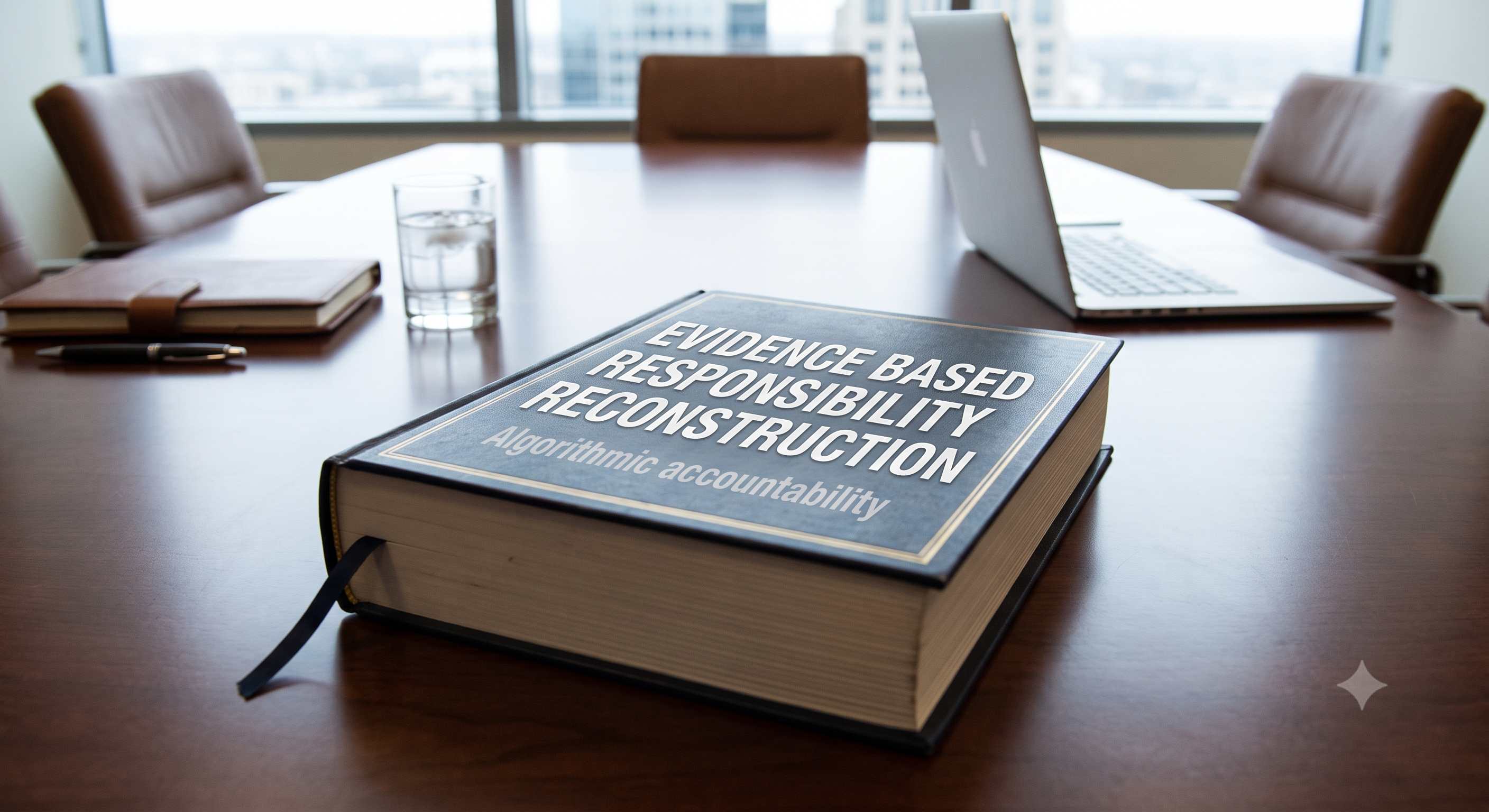
New framework helps establish accountability by showing what an AI’s paper trail can—and can’t—prove.
CHICAGO, IL, UNITED STATES, July 30, 2026 /EINPresswire.com/ — Lozen Advisory today published Evidence-Based Responsibility Reconstruction for AI-Mediated Conduct, defining a formal method for evaluating whether the surviving record of an AI incident can connect specific actors to specific governance acts.
The gap it addresses is a familiar one: without responsibility reconstruction, “accountability” often becomes a policy promise — accountable for which act, on what evidence, under what authority, and to whom?
That distinction is increasingly urgent: federal standards for machine-generated evidence remain unsettled — including Proposed Federal Rule of Evidence 707, sent back for revision after a contested public comment period — even as automated governance-attestation tools proliferate.
A Gap Between Policy and Proof
After an agentic AI incident, what evidence remains, and where can responsibility be established?
Boards, general counsel, insurers, and regulators are asking a version of the same question with growing frequency: when an AI system’s conduct causes harm—who was responsible, and can it be proven? Lozen Advisory’s position is that the existing landscape of AI governance work is searching for the terminology to answer that question.
Designed for corporate boards, general counsel, enterprise risk leaders, and insurers, the framework establishes a standardized protocol for evaluating AI liability exposure before and after incidents occur. It provides institutional stakeholders with the terminology needed to audit AI oversight records, establish LLM governance structures, and navigate emerging regulatory scrutiny.
Lozen Advisory defines Evidence-Based Responsibility Reconstruction as the disciplined process of evaluating:
1. Action: What the AI system did.
2. Authority: What authority it was granted.
3. Control: Which human and institutional actors set the conditions for its conduct.
4. Evidence: What digital record remains.
5. Responsibility: Where responsibility can be established, divided, or no longer recovered.
“AI accountability requires more than naming a responsible party in a policy,” said Akilah E. Kamaria, founder of Lozen Advisory. “The surviving record must be able to connect actors to the governance decisions surrounding the conduct.”
The publication introduces the Responsibility Reconstruction Protocol℠ and the Lozen Evidence-State Scale℠, which classifies evidentiary records into four states: Reproducible, Traceable, Attributable only, or Unrecoverable.
The complete definition, category boundaries, terminology, and supporting analysis are published on the Lozen Advisory website as the official version of record.
About Lozen Advisory
Lozen Advisory provides strategic counsel to boards, CFOs, and general counsel on algorithmic accountability, AI governance evidence, and the financial and institutional risks created as AI systems take on greater autonomy. Its published frameworks include Disclosure-Independent Governance℠, the Power User Trap℠, the Name Standard℠, the Responsibility Reconstruction Protocol℠, and the Lozen Evidence-State Scale℠. Learn more at lozenadvisory.com.
AKILAH E. KAMARIA
Lozen Advisory LLC
media@lozenadvisory.com
Visit us on social media:
LinkedIn
Legal Disclaimer:
EIN Presswire provides this news content “as is” without warranty of any kind. We do not accept any responsibility or liability
for the accuracy, content, images, videos, licenses, completeness, legality, or reliability of the information contained in this
article. If you have any complaints or copyright issues related to this article, kindly contact the author above.

Media gallery