
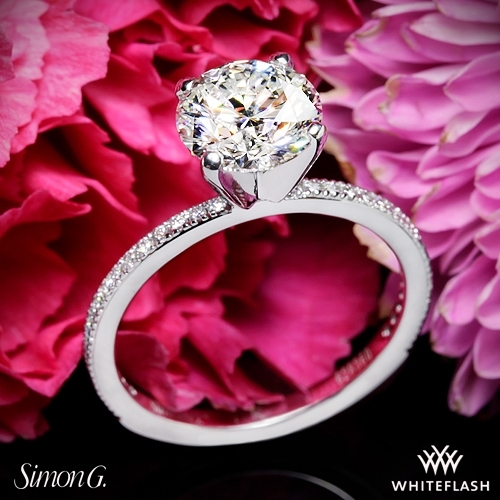
Houstan, Texas – September 16, 2026 – A loose diamond and an engagement ring setting can appear compatible on separate product pages without being suitable for one another in their exact specifications. The most common source of confusion is carat weight, which measures mass but does not describe the physical dimensions a setting must accommodate.
Whiteflash has identified eight points shoppers should compare before choosing the two components separately: diamond shape, millimeter measurements, published center-size guidance, head style, prong layout, protection for points and corners, wedding-band clearance, and any model-specific restrictions. Together, they show why compatibility depends on the actual diamond and the actual setting rather than a carat label alone.
Carat Weight Does Not Establish Fit
A setting holds a diamond at its girdle and must accommodate its diameter, depth, outline, and any points or corners. Two diamonds with the same carat weight can have different measurements and may sit differently in the same mounting. A description such as “for a one-carat center” is therefore a scale reference, not a universal fit guarantee.
Round diamonds are commonly compared by diameter and depth. Ovals, pears, marquises, emerald cuts, radiants, and cushions introduce length, width, and length-to-width ratio. Those differences become particularly important in settings with fixed halos, side diamonds, or heads designed for a narrow range of dimensions.
Shoppers comparing loose diamonds can use the measurements on the grading report alongside the setting specifications. Shape, dimensions, and the manufacturer’s center-size guidance should agree before appearance enters the discussion.
Diamond Shape Determines the Required Support
The head and prongs must follow the outline of the diamond. A round head distributes support around a circular girdle, while oval, square, rectangular, and pointed shapes require different geometry. Some setting models can be made for several center shapes, but a product image cannot confirm that flexibility for a particular diamond.
Points and corners require special attention. Pear and marquise diamonds commonly use V-tip prongs at their points, while square and rectangular shapes may call for corner prongs, tab prongs, a bezel, or a partial bezel. The aim is to secure vulnerable areas without allowing the metal to dominate the face-up appearance.
Prong count alone does not settle the issue. Placement, proportion, and workmanship matter with it. The main prong-setting styles used for diamond rings create different balances among visibility, support, profile, and maintenance.
“Carat weight is not a dimensional measurement, so it cannot settle compatibility on its own. The dimensions and outline of the diamond have to work with the head, prongs, and profile of the setting,” said Bryan Boyne, VP at Whiteflash.
The Side Profile Can Change the Choice
Compatibility continues below the girdle. Basket depth, gallery construction, setting height, and decorative elements beneath the center can affect pavilion clearance, how the ring feels on the hand, and whether a wedding band fits well with it.
A straight wedding band may sit flush with one engagement ring and leave a significant gap beside another. Hidden halos, wide baskets, low galleries, and deep center diamonds can all change that relationship. The gap is not necessarily a defect, but it should be understood as part of the design before the engagement ring is ordered.
Top, side, and three-quarter views answer different questions. The top view shows outline and prong placement, while the other angles reveal head height, gallery structure, and the relationship between the center setting and the shoulders of the ring.
The Exact Diamond and Setting Have the Final Say
Filters for shape, carat weight, setting type, metal, ring width, and center size can narrow the field, but they cannot replace a review of the exact pairing. Published specifications for engagement ring settings establish the boundaries of each model, including fixed-head, halo, side-diamond, ring-size, and manufacturing limitations where they apply.
A complete comparison brings the eight checks together. The diamond must match the accepted shape and measurement range, the head must accommodate its depth, the prongs must suit its outline, vulnerable points or corners must be protected, the profile must work with the intended wedding band, and the model must allow the requested configuration.
Choosing the diamond and setting separately can give shoppers greater control over the finished ring. That control is most useful when both components are evaluated as one piece of jewelry before the order is finalized. When a matching wedding set is the ultimate goal, Whiteflash strongly advises purchasing both together to ensure a proper match.
About Whiteflash
Whiteflash is a modern jeweler specializing in precision cut diamonds, designer engagement rings, and fine diamond jewelry. As the exclusive home of A CUT ABOVE® Super Ideal natural diamonds, Whiteflash is internationally recognized for scientific light-performance analysis, including ASET, Ideal-Scope, and Hearts & Arrows imaging. Based in Houston, Texas, Whiteflash serves a global clientele and is an authorized retailer for the finest brand name designers including Tacori, Verragio, Simon G., A. Jaffe, and Vatche. Whiteflash offers the Lifetime Upgrade Program on individually certified loose A CUT ABOVE® diamonds.
Media Contact
Company Name: Whiteflash Inc.
Contact Person: Tiffany Moore
Email: Send Email
Phone: 8322526770
Address:2150 Town Square Place Suite 330
City: Sugar Land
State: TX
Country: United States
Website: Whiteflash.com
Press Release Distributed by ABNewswire.com
To view the original version on ABNewswire visit: Choosing a Diamond and Setting Separately: Whiteflash Identifies Eight Compatibility Checks to Make Before Ordering


